
Journalists work with large amounts of spoken information every day. Interviews, press conferences, voice notes, public statements, field recordings, and panel discussions all contain details that need to be captured accurately. Turning this audio into text helps reporters move faster from reporting to writing. It also makes it easier to search for quotes, verify names, review timelines, and organize source material. For newsrooms, freelancers, and independent creators, AI transcription can reduce manual work and support a more efficient editorial process without changing the core standards of reporting.
Audio transcription is especially useful in journalism because speed and accuracy both matter. A reporter may need to publish a breaking story quickly, but still confirm exact wording from a source. Listening back to long recordings several times can take a lot of time, especially when multiple interviews are involved. A text transcript gives structure to raw material. It allows journalists to scan for key passages, compare statements from different speakers, and return to important moments without restarting the audio. This can improve productivity while helping maintain clear records of what was said and when it was said.
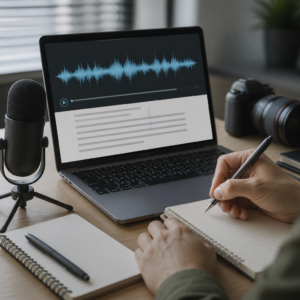
How journalists use transcripts in daily work
In practical terms, transcripts support almost every stage of reporting. During research, they help identify themes, recurring claims, and strong quotes. During writing, they make it easier to pull exact wording into an article or script. During editing, they give editors a way to check facts and ensure quotes match the source audio. Transcripts can also support collaboration inside a newsroom, since multiple team members may need to review the same interview. Instead of sharing only an audio file, a reporter can share searchable text that saves time for everyone involved. This is useful for long-form reporting, fast news coverage, and multimedia production.
Journalists often work in challenging recording conditions, which makes a good workflow important. Interviews may happen in noisy public spaces, over phone calls, or during live events with overlapping voices. While AI transcription can handle many common file types and speaking styles, the quality of the final transcript depends heavily on the quality of the source recording. Using a clear microphone, reducing background noise when possible, and asking speakers to identify themselves can make later review much easier. Even when the first transcript is not perfect, it still provides a strong starting point that can be corrected faster than typing everything from scratch.
Why searchable text improves reporting speed
One major advantage of transcription for journalists is searchability. A recorded interview may last an hour, but a transcript lets a reporter search for a person’s name, a place, a date, or a specific topic in seconds. This is valuable when working across several recordings for one story. Instead of relying on memory or handwritten notes, a reporter can go directly to the right section, confirm context, and extract supporting detail. Searchable text also helps with follow-up reporting. If a story develops over time, older transcripts remain a useful archive that can be revisited when new facts emerge.
Transcripts also make it easier to maintain organized records. Journalists often need to keep material for reference, legal review, or future stories. Text files are simpler to label, sort, and store than raw audio alone. A clear naming system based on source, date, and topic can turn a large set of interviews into a useful reporting archive. This matters not only for individual reporters, but also for editorial teams that need consistent documentation. When source material is well organized, fact-checking becomes more efficient, corrections are easier to manage, and future reporting can build on a stronger foundation.
Best practices for accurate and responsible use
Although AI transcription can save time, journalists should still treat transcripts as working documents that need review. Proper names, technical terms, place names, and numbers deserve special attention. It is good practice to compare important quotes against the original audio before publication, especially in sensitive stories. Reporters should also watch for places where punctuation changes meaning or where multiple speakers are difficult to separate. Responsible use of transcripts means combining speed with verification. AI can assist the process, but editorial judgment remains essential for accuracy, fairness, and clear attribution.
Privacy and source protection also matter when transcribing journalistic material. Some recordings may contain sensitive interviews, unpublished reporting, or confidential background information. Before uploading files to any tool, journalists should consider the sensitivity of the content and follow their organization’s policies. It is important to understand who can access the transcript, how files are stored, and whether the material includes personal data. In many cases, careful file handling is just as important as the quality of the transcript itself. A useful workflow should support both reporting efficiency and responsible information management.
For journalism, audio transcription is not only a convenience. It is a practical tool that supports faster research, stronger quote verification, better collaboration, and more organized reporting. It helps reporters turn spoken material into a searchable resource that can be used throughout the editorial process. Whether covering breaking news, long interviews, or recorded statements, journalists benefit from having text that is easier to review than audio alone. As part of a careful workflow, AI transcription can help news professionals spend less time on manual typing and more time on analysis, verification, and storytelling.


